
Pioneer of Open-Source AI and Research Reproducibility
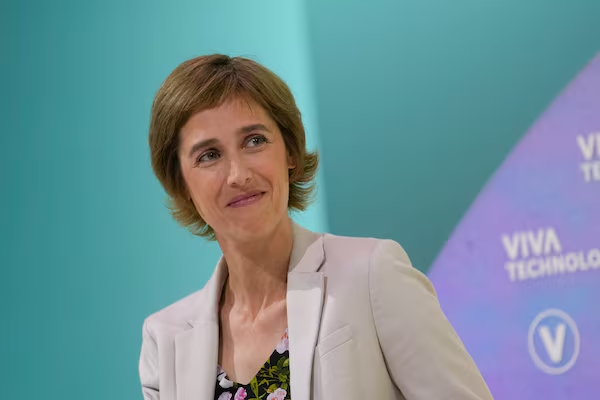
Dr. Joelle Pineau stands as one of the most influential voices in artificial intelligence research, combining groundbreaking technical contributions with unwavering advocacy for open science and research reproducibility.
As the former Vice President of AI Research at Meta (formerly Facebook AI Research) and current Chief AI Officer at Cohere, she has led some of the world’s most impactful AI research while championing accessible, transparent, and reproducible science that benefits everyone.
It’s so important that we don’t end up with a field that is homogeneous. We need to create a space that’s welcoming for everyone because the quality of the research will be so much better.
Professional Background and Current Role
Born in 1974, Dr. Joelle Pineau currently serves as Chief AI Officer at Cohere, a position she assumed in August 2025 after leaving Meta in May 2025. During her eight-year tenure at Meta, she led the company’s Fundamental AI Research (FAIR) group since 2023, overseeing cutting-edge computer science research across 500 employees in 10 labs across five time zones. Her work at Meta helped guide the early development of open-source Llama AI models alongside renowned neural network pioneer Yann LeCun.
At Cohere, Pineau oversees AI strategy across research, product, and policy teams, focusing on developing AI agents in private and secure settings and creating benchmarks to evaluate these systems. She is particularly interested in exploring how networks of AI agents interact with each other in real-world applications.
Academic Foundation and Research Excellence
Pineau is a William Dawson Scholar and Professor at McGill University, where she co-directs the Reasoning and Learning Lab. She is also a core academic member of Mila – Quebec Artificial Intelligence Institute and holds a Canada CIFAR AI Chair. Her academic credentials are impressive: a BASc in Engineering from the University of Waterloo, and both MSc and PhD in Robotics from Carnegie Mellon University.
Her research focuses primarily on developing new models and algorithms for planning and learning in complex, partially observable domains, with applications in robotics, healthcare, games, and conversational agents. She has published over 200 papers and has been cited over 38,000 times, establishing her as one of the most influential researchers in her field.
Revolutionary Contributions to AI Research
Healthcare and Robotics Innovation
Pineau pioneered the application of reinforcement learning to personalized medicine, using data from medical charts, X-ray images, clinical notes, and lab reports to generate new treatment strategies. Her team developed deep learning techniques for detecting seizures and worked on optimizing neurostimulation technology to reduce epileptic seizures through collaboration with the Montreal Neurological Institute.
She founded two startups developing robotic assistants for the elderly: the SmartWheeler initiative (a multi-modal wheelchair combining AI and robotics) and the Nursebot platform. Her work on adaptive treatment strategies extends to mental health conditions including depression and schizophrenia, and cancer treatment optimization using computational modeling.
Reinforcement Learning Breakthroughs
As a specialist in reinforcement learning, Pineau has developed fundamental algorithms for partially observable Markov decision processes (POMDPs). Her work on Bayesian reinforcement learning has established new standards for learning in uncertain environments. She has applied these algorithms to complex real-world problems spanning robotics, healthcare, and conversational AI systems.
Open-Source AI Leadership at Meta
During her time at Meta, Pineau championed open science principles, helping develop models like BlenderBot 3 – the first 175-billion parameter publicly available chatbot with open model weights, code, datasets, and model cards focusing on safety and explainability. Her commitment to open-source AI has made cutting-edge research accessible to the global research community.
Champion of Research Reproducibility
Perhaps Pineau’s most transformative contribution to the AI field has been her leadership in addressing the reproducibility crisis. She served as the inaugural Reproducibility Chair for the Neural Information Processing Systems (NeurIPS) conference in 2019, where she introduced revolutionary changes to academic publishing standards.
The Machine Learning Reproducibility Checklist
Pineau created the Machine Learning Reproducibility Checklist, now a requirement for paper submissions to major AI conferences. This checklist ensures researchers provide essential details about data, models, compute resources, and experimental assumptions, making research more transparent and replicable.
Reproducibility Challenge Initiative
She launched the ML Reproducibility Challenge, starting at ICLR 2018 and expanding to major conferences including NeurIPS, ICML, ACL, EMNLP, CVPR, and ECCV. This competition encourages scientists to reproduce each other’s research, with over 173 participants from 73 institutions in recent iterations.
Impact on Publishing Standards
Under her leadership, the percentage of papers including code links increased dramatically – reaching 75% at NeurIPS 2019. Her efforts have fundamentally changed how AI research is conducted, communicated, and evaluated across the scientific community.
Recognition and Leadership Roles
Pineau’s contributions have earned numerous prestigious recognitions:
- Governor General’s Innovation Award (2019) for leadership in innovative applications of AI and machine learning to personalized medicine
- NSERC E.W.R. Steacie Memorial Fellowship (2018)
- Fellow of the Association for the Advancement of Artificial Intelligence (AAAI)
- Fellow of the Royal Society of Canada (2023) for contributions to machine learning research with focus on Bayesian learning and planning under uncertainty
- Senior Fellow of the Canadian Institute for Advanced Research (CIFAR)
- Past President of the International Machine Learning Society
She serves on editorial boards of the Journal of Artificial Intelligence Research and Journal of Machine Learning Research, and was Program Chair (2012) and General Chair (2015) of the International Conference on Machine Learning (ICML).
What Women in the Field Can Learn from Dr. Joelle Pineau
1. Combine Technical Excellence with Ethical Leadership
Pineau demonstrates how to excel technically while leading ethical transformation in the field. Her advocacy for reproducibility and open science shows that women can drive systemic change while building outstanding technical careers. This combination of expertise and ethical leadership creates lasting impact beyond individual research contributions.
2. Champion Transparency and Open Science
Her commitment to open-source AI and research reproducibility illustrates how women can lead by making science more accessible and democratic. By advocating for transparency, women can help ensure AI benefits everyone rather than remaining concentrated in a few organizations.
3. Bridge Academic Research with Industry Impact
Pineau’s success in both academic and industry settings shows how women can create influence across different sectors. Her ability to maintain academic rigor while leading large-scale industry research demonstrates that women don’t have to choose between pure research and practical impact.
4. Address Systemic Problems in the Field
Rather than accepting the status quo, Pineau identified and addressed the reproducibility crisis head-on. Women can follow her example by tackling systemic issues in AI research, whether related to bias, accessibility, ethics, or methodology.
5. Focus on Human-Centered Applications
Her work in healthcare, assistive robotics, and personalized medicine shows how to direct AI research toward solving real human problems. Women can differentiate themselves by prioritizing applications that improve quality of life and address social challenges.
6. Build Strong Academic-Industry Collaborations
Pineau’s success in maintaining academic positions while leading industry research creates a model for women who want to maximize their impact across sectors. This dual affiliation allows for both fundamental research freedom and real-world application opportunities.
7. Lead Through Service to the Community
Her roles in editorial boards, conference organization, and initiative leadership demonstrate how service can amplify individual impact. Women can build influence and drive change by taking on leadership roles in professional organizations and conferences.
8. Create Institutional Change Through Standards
By establishing the reproducibility checklist and challenge, Pineau shows how individual leadership can create field-wide changes. Women can effect systematic change by developing standards, protocols, and frameworks that improve research practices.
9. Mentor Through Action and Example
Her leadership in making research more accessible effectively mentors the entire field by teaching better practices. Women can amplify their impact by creating systems and standards that help others succeed.
Key Resources and Links
Professional Profiles:
- McGill University Faculty Page: https://www.cs.mcgill.ca/~jpineau/
- Twitter/X: https://x.com/jpineau1
- Google Scholar: https://scholar.google.com/citations?user=CEt6_mMAAAAJ
- Mila Profile: https://mila.quebec/en/directory/joelle-pineau
Reproducibility Resources:
- ML Reproducibility Checklist: https://www.cs.mcgill.ca/~jpineau/ReproducibilityChecklist.pdf
- Research Publications: https://www.cs.mcgill.ca/~jpineau/publications.html
Notable Recognition:
- Governor General’s Innovation Award: https://www.mcgill.ca/newsroom/channels/news/governor-generals-innovation-award-ai-pioneer-joelle-pineau-297076
- Wikipedia Profile: https://en.wikipedia.org/wiki/Joëlle_Pineau
Recent Coverage:
- Cohere Appointment: https://techcrunch.com/2025/08/14/cohere-hires-long-time-meta-research-head-joelle-pineau-as-its-chief-ai-officer/
- Meta Departure: https://www.cnbc.com/2025/04/01/metas-head-of-ai-research-announces-departure.html
Vision for AI’s Future
Pineau advocates for AI development that prioritizes human benefit over purely technical advancement. Her current work at Cohere focuses on practical AI applications that deliver real productivity improvements across industries, rather than pursuing artificial general intelligence (AGI) without clear use cases.
She emphasizes the importance of networks of AI agents working together in real-world settings and the development of robust evaluation benchmarks for these systems. Her approach balances technical innovation with practical utility and ethical considerations.
Technical Contributions and Publications
Pineau has authored influential papers on:
- Bayesian reinforcement learning and planning under uncertainty
- Deep reinforcement learning methodology and standardization
- Natural language processing and dialogue systems
- Healthcare applications of machine learning
- Robotics and human-robot interaction
Her 2018 paper “Deep Reinforcement Learning That Matters” highlighted reproducibility challenges in the field and established new standards for experimental reporting that are now widely adopted.
Legacy and Continuing Impact
Dr. Joelle Pineau represents a model of how women in AI can achieve exceptional technical contributions while driving positive change in research culture. Her advocacy for reproducible, open science has made AI research more democratic and accessible, while her technical work has advanced both theoretical understanding and practical applications.
Her career demonstrates that the most significant contributions to AI often come not just from algorithmic breakthroughs, but from improving how we conduct, validate, and share research. By combining technical excellence with ethical leadership and systemic thinking, she has created a framework for responsible AI development that will influence the field for generations.
For women in machine learning, Pineau’s career offers a blueprint for building influence through a combination of outstanding technical work, community service, and advocacy for positive change. Her success shows that women can lead not just individual research projects, but transformation of entire fields toward more ethical, transparent, and inclusive practices.
Dr. Joelle Pineau’s journey from robotics researcher to AI research leader and reproducibility advocate illustrates how interdisciplinary expertise, commitment to open science, and ethical leadership can create transformational impact in artificial intelligence research and practice.